What Are the Best China Stainless Steel Kitchen Bowls?

Time:2026-10-13 Author:Ethan
0%

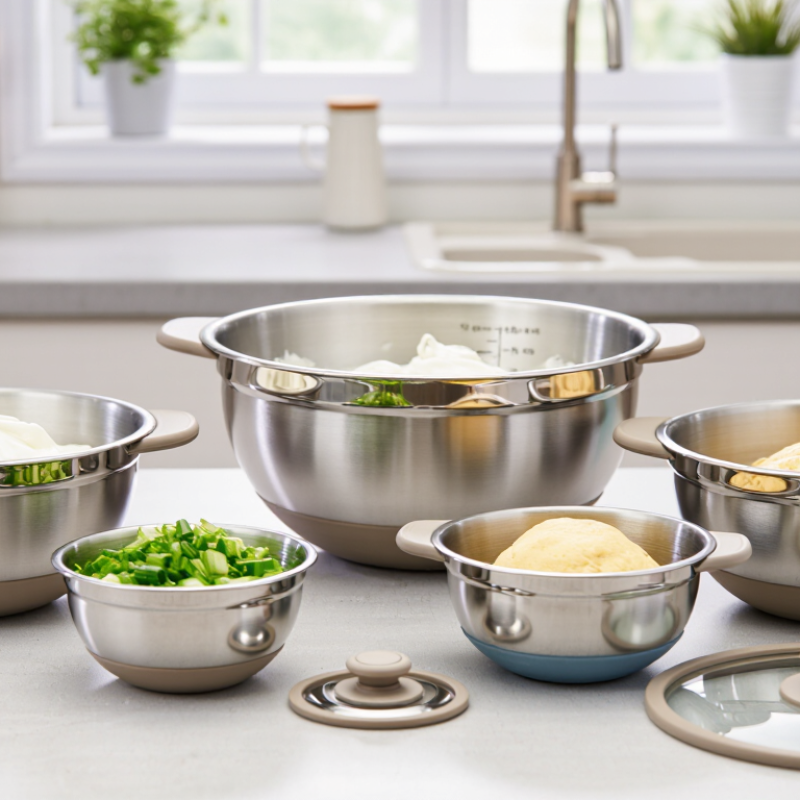
Choosing the best Stainless Steel Kitchen Bowls is not only about appearance or price. It is about how reliably they perform during real kitchen work. A good set should handle whisking, kneading, mixing, chilling, and storing without becoming difficult to clean. Bowl size, rim design, base stability, and material quality all influence daily use. Small details matter.

In this guide, we compare stainless steel bowls through practical kitchen experience and clear evaluation criteria. We consider rust resistance, wall thickness, balance, nesting efficiency, and compatibility with common cooking tasks. A stable bowl should stay firm when cream is whipped or dough becomes stiff. A smooth interior should release sauces without trapping residue around sharp seams. Lids, handles, measurement marks, and pouring edges also deserve attention.

Not every attractive set is genuinely useful. Some bowls feel sturdy in a product photo but flex under pressure. Others stack neatly yet slide across a wet counter. I have also found that very lightweight bowls can be convenient, but they may feel less secure during vigorous mixing. That trade-off is easy to overlook. User reviews can reveal these weaknesses, although they are not always consistent or independently verified. This article therefore balances manufacturer information with practical observations and common kitchen needs. The goal is not to name one universal winner. It is to help readers identify the most dependable Stainless Steel Kitchen Bowls for their cooking habits, available space, and budget. Before buying, consider what you actually prepare each week. That answer may change the ranking.
What Are the Best China Stainless Steel Kitchen Bowls?

Types of Stainless Steel Kitchen Bowls Made in China

China produces a wide range of stainless steel kitchen bowls, from small prep bowls to large mixing basins. Common types include nesting bowls, colanders, serving bowls, measuring bowls, and double-wall insulated designs. Many factories also make bowls with silicone bases, rolled rims, pouring lips, or sealed lids. These details affect grip, noise, cleaning, and storage.

Material choice deserves close attention. Type 304 stainless steel is widely selected for food-contact bowls because it offers strong corrosion resistance. Type 201 costs less, but it usually provides lower resistance in salty or acidic environments. Type 430 is magnetic and often used for practical, budget-oriented products.

The International Stainless Steel Forum reported about 58.4 million tonnes of global stainless steel production in 2023, with China contributing roughly 36.7 million tonnes. That scale supports broad manufacturing expertise, but quality still varies between suppliers. ASTM A240 and applicable Chinese food-contact standards can help verify material and safety claims.

Tips: Check the steel grade, wall thickness, weld quality, and rim finish. Rub the inside gently; it should feel smooth, not sharp. Ask for a recent material test report and food-contact documentation. In my experience, a polished surface can hide weak construction. I once preferred a lighter bowl for easy handling, but it dented quickly. Weight alone is not proof of quality. Nesting depth, base stability, and dishwasher guidance matter too. Look closely.

Key Features That Define a High-Quality Stainless Steel Bowl

When choosing China stainless steel kitchen bowls, material grade is only one part of quality. Type 304 stainless steel, often called 18/8, offers strong corrosion resistance for everyday cooking. Type 316 adds molybdenum and performs better around salt and acidic ingredients. ASTM A240 provides chemical and mechanical requirements for stainless steel sheet used in food equipment. The International Stainless Steel Forum reported about 58.4 million tonnes of crude stainless steel production worldwide in 2023, showing the material’s broad industrial importance.

Construction reveals more than a sales description. A high-quality bowl should have a smooth interior, rounded edges, and a stable base. These details reduce trapped food and simplify washing. The U.S. FDA Food Code requires food-contact surfaces to be corrosion-resistant, nonabsorbent, smooth, and easily cleanable. In practical inspection, I check the rim by touch. It should feel continuous, not sharp or uneven. I also examine the weld area closely.

Finish matters. A polished surface looks attractive, but bright reflections can hide shallow scratches. I once overvalued shine. That was a mistake. Wall thickness should feel balanced, not excessively thin or needlessly heavy. Excess weight alone does not prove durability. Bowls should also resist tipping during whisking, with a base that stays steady on a wet countertop. For Chinese manufacturers, buyers should request grade certificates, food-contact test records, dimensional checks, and salt-spray or corrosion results. Documentation is useful, but independent sampling remains necessary. One unchecked batch can weaken an otherwise careful quality system.

What Are the Best China Stainless Steel Kitchen Bowls?

Key Features That Define a High-Quality Stainless Steel Bowl

Stainless steel grades commonly used in kitchenware are compared by their representative chromium, nickel, and molybdenum content. Grade 304 is widely valued for food-contact applications, grade 316 provides enhanced resistance in salty or acidic environments because of its molybdenum content, and grade 430 offers magnetic performance with lower nickel content. Actual bowl quality also depends on surface finish, wall thickness, forming quality, weld control, and food-contact compliance.

How to Compare Chinese Stainless Steel Bowl Manufacturers

What Are the Best China Stainless Steel Kitchen Bowls?

When comparing Chinese stainless steel bowl manufacturers, start with the metal grade, not the showroom finish. For daily kitchen use, 304 stainless steel is common, while 316 can offer better resistance in demanding environments. Ask for material certificates and verify them through independent testing when the order is important.

Check the bowl’s actual thickness, weight, and dimensional tolerance. A reliable factory should provide samples from regular production, not only polished display pieces. Inspect the rim closely. It should feel smooth, even, and comfortable in the hand. Welded handles need clean joints without pinholes or sharp edges. A shiny sample can still mislead.

Factory experience matters. Review production records, inspection procedures, and traceability from coil to packed bowl. Ask how workers check dents, scratches, polishing marks, and nesting accuracy. Food-contact test reports should match the finished product and destination requirements. Packaging also deserves attention; thin separators may leave scuff marks during shipment.

Communication reveals more than brochures. Request clear answers about tooling, minimum quantities, lead times, and correction procedures. During one sample review, I found that a small diameter difference affected stacking stability. It looked minor, but it changed carton capacity. That detail was easy to miss. Video inspections and pre-shipment checks can reduce surprises, although they cannot replace careful sampling.

Safety, Durability, and Certification Standards to Check

When evaluating China stainless steel kitchen bowls, I check safety before appearance. Food-contact surfaces should be smooth, clean, and free from peeling coatings. Stainless steel grades such as 304 are common for kitchen use, while 316 may offer better resistance in salty environments. However, grade labels alone are not enough. Ask for material composition reports and food-contact testing.

Certification should match the selling market. For China, look for compliance with relevant GB food-contact standards, including GB 4806.9 for metal products. Export buyers may also request FDA, LFGB, or EU compliance documents. Check whether reports identify the exact bowl material, production site, and testing date. Generic certificates can be misleading. Traceability matters.

Tips: Inspect the rim for sharp edges, dents, and uneven polishing. Test the bowl on a flat surface. It should not wobble. Ask about nickel release, lead, cadmium, and migration testing. A magnet test may help identify steel differences, but it cannot prove safety. I also prefer bowls with clear care instructions and consistent welds. One practical concern remains: some suppliers provide excellent samples but inconsistent bulk production. A pre-shipment inspection is worth considering.

What Are the Best China Stainless Steel Kitchen Bowls? - Safety, Durability, and Certification Standards to Check

Evaluation Dimension Recommended Requirement Why It Matters Evidence or Standard to Check Practical Assessment
Primary stainless-steel grade Food-contact grade such as 304 stainless steel for general kitchen use 304 offers good corrosion resistance and is widely used for food-contact utensils and cookware Material declaration, mill certificate, or grade verification report; confirm compliance with applicable Chinese food-contact requirements Best general-purpose option
Enhanced corrosion resistance 316 or 316L stainless steel where bowls may contact salty, acidic, or marine-related foods frequently Molybdenum-containing 316 grades generally resist chloride-related corrosion better than 304 Grade identification, chemical composition report, and food-contact migration testing where required Premium durability choice
Lower-cost stainless grades 430 may be suitable for dry or low-corrosion applications; 201 requires closer quality verification These grades can differ in nickel content and corrosion performance, especially in humid or salty conditions Do not rely only on surface appearance; request material composition or third-party grade testing Acceptable only after verification
Food-contact safety Finished bowl must not release hazardous substances above applicable limits under intended use The finished product, welds, polishing residues, coatings, and decorative parts all affect safety Check applicability of China GB 4806.1 and GB 4806.9, plus a current food-contact test report for the finished product Essential requirement
Heavy-metal migration Migration results must comply with the limits required by the destination market and intended food-contact conditions Nickel, chromium, lead, and other elements may be assessed during food-contact testing Laboratory report showing test methods, simulants, contact time, temperature, limits, and pass results Require documented test results
Wall thickness and rigidity A stable, evenly formed bowl with no sharp deformation; thickness should match the intended size and use Adequate thickness improves resistance to denting, warping, and premature fatigue Supplier specification, dimensional inspection, and sample testing; avoid judging quality by thickness alone Check consistency across samples
Surface finish Smooth, cleanable surface without pits, cracks, exposed burrs, or embedded polishing compound A sound finish reduces food retention and makes cleaning more effective Visual inspection, tactile inspection, and cleaning test; verify that polishing compounds are removed High priority for hygiene
Welds, rims, and seams Rims should be smooth and secure; welds should be continuous, clean, and free from cracks or visible corrosion Poorly finished edges can cause injury and trap food or cleaning residues Production inspection records, edge-safety checks, and close examination of weld areas Reject sharp or rough edges
Dishwasher and heat suitability Use only when the product specification confirms dishwasher and temperature suitability Repeated heat, detergents, and drying cycles can expose weak finishes or dissimilar-metal components Care instructions, repeated-cycle testing, and confirmation for any silicone, plastic, or coated parts Verify intended use
Dimensional and functional stability Base should sit level; bowl should resist tipping, excessive flexing, and distortion during normal use Stable geometry improves safety and reduces spills Flatness, nesting, capacity, rim diameter, and tipping checks against approved drawings Important for daily handling
Traceability and quality control Each production batch should be traceable to raw material, inspection records, and test results Traceability makes it easier to investigate defects and maintain consistent quality Batch code, inspection plan, certificate of analysis, retained samples, and corrective-action records Strong indicator of reliable production
Export-market documentation Documentation should match the destination market rather than relying on a generic certificate Food-contact rules and testing requirements vary between China, the European Union, the United States, and other markets For China, review applicable GB requirements; for other destinations, check relevant local food-contact regulations and recognized laboratory reports Confirm before purchase or import
Selection summary: For most kitchen applications, a properly finished 304 stainless-steel bowl with verified food-contact documentation is a balanced choice. Consider 316 stainless steel for frequent exposure to salty or acidic foods, and request finished-product migration reports, material verification, and batch traceability before purchase.

How to Choose the Best Stainless Steel Bowls for Your Kitchen

Choosing the best stainless steel kitchen bowls requires more than admiring a polished surface. In daily cooking, I check the steel grade, wall thickness, rim, and base stability. Food-grade 304 stainless steel suits most kitchens because it resists rust and common kitchen acids. A thicker bowl feels steadier when mixing dough or whisking eggs. Thin bowls can flex easily. That is annoying.

Look closely at the inner surface. It should feel smooth, without sharp edges, deep scratches, or uneven welds. A rolled rim improves comfort and reduces spills while pouring batter. Nested sizes save cabinet space, but very tight stacking can trap moisture. Let each bowl dry fully after washing. I once stored wet bowls together and noticed small water marks later. They were harmless, but avoidable. My earlier assumption was wrong: a mirror finish does not always mean better performance.

Tips: Choose bowls with flat, non-slipping bases for busy counters. Test whether the smallest bowl can be removed easily from the stack. Use stainless steel for mixing, but avoid storing strongly salty foods for long periods. Check the product’s food-contact information and care instructions before buying. If you often prepare hot sauces, select heat-resistant bowls with comfortable side grips. A practical set should feel balanced in your hands, clean easily, and match your cooking habits—not merely look impressive on a shelf.

FAQS

Which stainless steel grade suits most kitchen bowls?

Type 304 suits most daily cooking because it resists rust and common kitchen acids. Type 316 performs better with salty or acidic ingredients. Grade alone does not prove quality.

How can I inspect a bowl’s construction?

Touch the rim around the entire bowl. It should feel smooth, continuous, and free from sharp spots. Check the inner surface for scratches, trapped food areas, and uneven welds.

Does a shiny finish mean better performance?

Not always. Bright reflections can hide shallow scratches and polishing marks. A smooth, cleanable surface matters more than mirror-like appearance.

What wall thickness should a good bowl have?

The bowl should feel balanced in your hand. Very thin walls may flex during whisking. Excessive weight does not automatically indicate stronger construction.

How important is the bowl’s base?

A stable, flat base helps during whisking and dough mixing. Test it on a slightly wet countertop. It should resist tipping and sliding. That matters.

What should buyers request from a manufacturer?

Request material certificates, food-contact records, dimensional checks, and corrosion results. Ask for samples from regular production. Display samples can mislead.

How should I compare different manufacturers?

Review inspection procedures, production records, and batch traceability. Ask about dents, scratches, welds, packaging, and delivery times. Clear communication is useful evidence.

What details affect stacking and storage?

Nested bowls save cabinet space, but tight stacking can trap moisture. Let each bowl dry fully before storage. I once ignored this and found water marks later.

What features help during everyday cooking?

Choose a comfortable rim, steady base, and easy-to-clean interior. Side grips help with hot mixtures. The smallest bowl should lift out without disturbing the stack.

Are independent inspections still necessary?

Yes, especially for large orders. Documents support trust, but sampling can reveal unnoticed problems. One unchecked batch may weaken an otherwise careful quality system.

Conclusion

China offers a wide range of Stainless Steel Kitchen Bowls designed for mixing, preparing, serving, and storing food. Common types include nesting bowls, deep mixing bowls, bowls with lids, measuring sets, and models with handles, pouring rims, or non-slip bases. A high-quality bowl should have food-grade stainless steel, a smooth polished surface, sturdy construction, stable edges, and a practical shape that is easy to clean and store. Thickness, weight, resistance to dents, and compatibility with daily kitchen tasks are also important factors.

When comparing Chinese manufacturers, buyers should evaluate material specifications, production consistency, customization capabilities, quality control procedures, packaging, and communication efficiency. Safety and durability should be supported by appropriate food-contact testing, corrosion resistance, hygienic finishing, and reliable certification documentation for the target market. To choose the best bowls, consider capacity, intended use, nesting convenience, comfort, cleaning requirements, and budget. A balanced combination of safe materials, functional design, dependable workmanship, and verified quality will provide lasting value for both household and professional kitchens.

Ethan

Ethan

Ethan is a seasoned marketing professional with a deep expertise in our company's innovative product line. With a passion for sharing knowledge and insights, he takes the lead in regularly updating our corporate blog, where he explores industry trends, product features, and effective marketing......