Commercial kitchens are becoming more compact, busier, and more accountable. Grand View Research’s commercial kitchen equipment report identifies continued market growth, driven by foodservice expansion and stricter hygiene expectations. That pressure makes sink selection more important than it appears.
This guide examines the Top 10 Types of 3 Sink Stainless Steel systems. It considers straight-line, corner, mobile, deep-bowl, compact, and custom configurations. Each design affects workflow, drainage, cleaning speed, and staff movement. The FDA Food Code 2022 supports separate washing, rinsing, and sanitizing steps. NSF/ANSI 2 also emphasizes cleanable, durable food-equipment surfaces.
Quality-management expert W. Edwards Deming said, “In God we trust; all others must bring data.” His point applies here. A polished sink can still fail when its bowls are shallow, its legs wobble, or its drainboard holds standing water. Small details matter. Very much.
The strongest choice depends on menu volume, available space, plumbing access, and cleaning routines. A narrow café may need a compact three-bowl unit. A busy hotel kitchen may require deeper basins, longer drainboards, and reinforced undershelves. Stainless steel offers corrosion resistance, but poor welds and thin gauges remain weaknesses. That part is easy to overlook.
This overview combines practical selection criteria with recognized food-safety guidance and market research. It also leaves room for reconsideration. Not every “commercial” sink performs equally well. Real performance begins with measurable specifications, installation quality, and daily use.
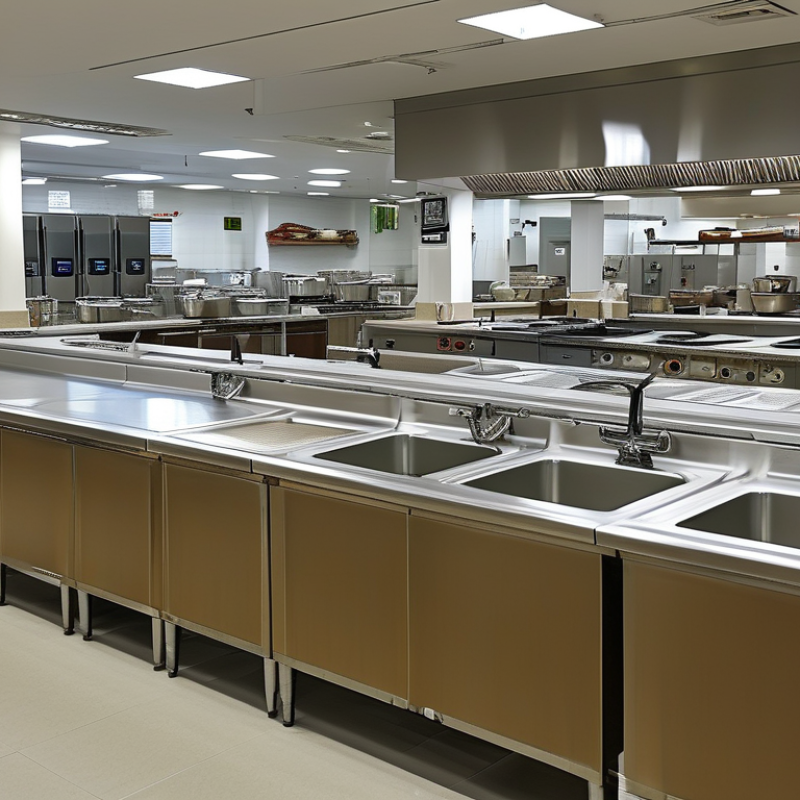
Three-sink stainless steel sinks are washing stations with three connected basins in one durable unit. They are commonly used for washing, rinsing, and sanitizing cookware, utensils, and food-service equipment. Each basin supports a separate task, helping reduce cross-contact during busy preparation periods.
The ten common types include equal-basin sinks, large-center-basin models, compact three-bowl sinks, corner units, wall-mounted sinks, freestanding sinks, undermount designs, drop-in models, drainboard sinks, and mobile sinks. Stainless steel offers a smooth, nonporous surface that is easy to clean and resistant to everyday moisture. However, basin depth, faucet clearance, drainage, and installation space affect real performance. A three-sink unit is not automatically practical. A narrow aisle can make even a high-quality sink frustrating to use.
Tips: Measure the available wall and floor space first. Check local sanitation requirements before installation. Choose deep basins for large pots, but avoid excessive depth if staff must bend often. A sloped drainboard can prevent standing water near the work area. One detail is easy to miss: the faucet should reach all three basins comfortably. Test the workflow with actual cookware, not only a product drawing. A small error there can become a daily inconvenience.
| No. | Type | Typical Configuration | Typical Overall Size | Typical Bowl Size | Common Material | Best Use | Main Characteristics |
|---|---|---|---|---|---|---|---|
| 1 | Equal-Bowl Three-Compartment Sink | Three compartments with the same width and depth | 72–96 in W × 24–30 in D × 34–44 in H | 14–20 in W × 14–20 in D × 10–14 in deep | Usually 18-gauge or 16-gauge Type 304 stainless steel | General commercial dishwashing | Provides balanced capacity for washing, rinsing, and sanitizing. |
| 2 | Large-Center-Bowl Sink | Smaller outer compartments with a wider center compartment | 72–90 in W × 24–30 in D × 34–44 in H | Outer: 12–16 in; center: 18–24 in wide; 10–14 in deep | Typically Type 304 stainless steel | Large pots, trays, and food-service utensils | The center bowl accommodates oversized items while retaining three stages. |
| 3 | Large-Left-Bowl Sink | Wide compartment on the left with two standard compartments on the right | 72–96 in W × 24–30 in D × 34–44 in H | Left: 18–24 in wide; other bowls: 14–20 in wide; 10–14 in deep | Commonly 18-gauge Type 304 stainless steel | Layouts where large-item washing begins on the left | Supports a left-to-right workflow with a larger initial washing area. |
| 4 | Large-Right-Bowl Sink | Two standard compartments on the left and a wider compartment on the right | 72–96 in W × 24–30 in D × 34–44 in H | Right: 18–24 in wide; other bowls: 14–20 in wide; 10–14 in deep | Commonly 18-gauge Type 304 stainless steel | Layouts where large-item washing begins on the right | A practical option for right-to-left traffic and equipment placement. |
| 5 | Three-Compartment Sink with Drainboards | Three bowls with one or two attached drainboards | 84–120 in W × 24–30 in D × 34–44 in H | 14–20 in W × 14–20 in D × 10–14 in deep | Usually 16- or 18-gauge Type 304 stainless steel | Kitchens needing dedicated air-drying or staging space | Sloped drainboards help water flow back toward the sink or drain area. |
| 6 | Three-Compartment Sink with Backsplash | Three bowls with a raised rear backsplash | 72–96 in W × 24–30 in D × 44–60 in overall H | 14–20 in W × 14–20 in D × 10–14 in deep | Typically Type 304 stainless steel | Wall-side installation in busy wash areas | The backsplash helps protect the wall from splashes and simplifies cleanup. |
| 7 | Under-Shelf Three-Compartment Sink | Three bowls mounted above a lower storage shelf | 72–96 in W × 24–30 in D × 34–44 in H | 14–20 in W × 14–20 in D × 10–14 in deep | 16- or 18-gauge stainless steel; shelf often stainless steel | Storage-conscious kitchens and utility rooms | Uses the space below the bowls for pots, racks, or cleaning supplies. |
| 8 | Adjustable-Leg Three-Compartment Sink | Three bowls supported by height-adjustable tubular legs | 72–96 in W × 24–30 in D × 34–44 in H | 14–20 in W × 14–20 in D × 10–14 in deep | Usually Type 304 stainless steel with stainless legs | Floors with minor level variations | Adjustable feet improve stability and help align the sink with plumbing. |
| 9 | Mobile Three-Compartment Sink | Three bowls mounted on a wheeled frame with locking casters | 72–96 in W × 26–34 in D × 36–46 in H | 12–18 in W × 14–20 in D × 10–14 in deep | Typically Type 304 stainless steel | Temporary kitchens, event service, and flexible work areas | Mobility is useful, but water supply, drainage, and caster locking are essential. |
| 10 | Corner Three-Compartment Sink | Three compartments arranged along two adjoining sides | 48–72 in per side × 24–30 in D × 34–44 in H | 12–18 in W × 14–20 in D × 10–14 in deep | Commonly 18-gauge Type 304 stainless steel | Compact kitchens and corner installations | Makes use of corner space while preserving the three-stage washing process. |
: It is one unit with three connected basins for washing, rinsing, and sanitizing cookware.
Separate basins help organize cleaning steps and reduce cross-contact during busy kitchen work.
Common designs include equal bowls, unequal bowls, corner units, wall-mounted models, freestanding units, and mobile sinks.
Match the largest basin to your main cookware. A 16-inch bowl handles plates better than a 10-inch bowl.
Drainboards provide temporary drying space. Double drainboards suit busy kitchens, but they may reduce preparation area.
Deep basins fit large pots, but they may strain shorter workers. Shallow basins improve access, though water can splash.
Measure wall length, floor space, doorways, plumbing points, faucet reach, and walking clearance.Measure twice.
The faucet should reach all three basins comfortably. Test it with actual cookware, not only a drawing.
Stainless steel has a smooth, nonporous surface that resists everyday moisture and supports routine cleaning.
Yes. A large sink may waste preparation space, and the wrong bowl position can slow daily work.That detail matters.
This guide explores the main types of 3 Sink Stainless Steel sinks and explains how their designs support efficient washing, rinsing, sanitizing, and food-service workflows. It begins by defining three-compartment sinks and comparing bowl configurations, including equal, unequal, deep, shallow, rounded, and divided basins. It also reviews installation and mounting styles such as freestanding, wall-mounted, undercounter, and modular designs, helping readers understand how each option affects space, access, drainage, and cleaning.
The guide further examines workstation features and practical applications, including drainboards, splash guards, adjustable legs, utility shelves, pre-rinse fixtures, and integrated storage. These features can improve organization in restaurants, commercial kitchens, schools, hospitality facilities, and other demanding environments. Finally, it explains how to choose the right sink by considering available space, bowl capacity, material thickness, hygiene requirements, plumbing compatibility, workflow, maintenance, and budget. The goal is to help buyers select a durable, functional, and easy-to-clean three-compartment sink suited to their specific needs.

 Jinrenkang Hardware